Plates
18 pictures, in the order they were drawn. Click one for the full-size image.
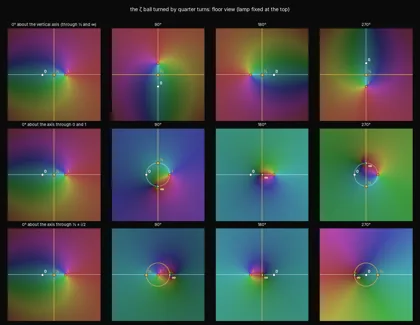 1Quarter turns
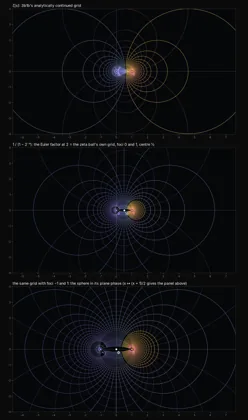 2The plane phase
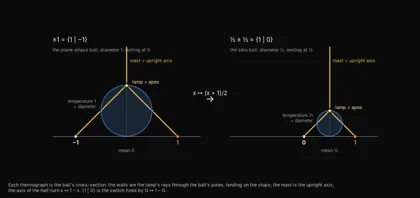 3Thermographs as resting balls
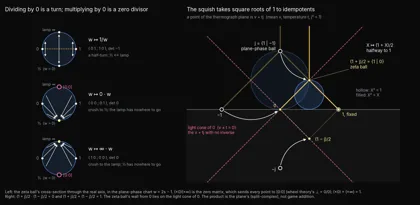 4Dividing by zero is a turn
 5The ball as a box kite
 6The centre becomes the bottom
 7Light stays light
 8A pair from one point of light
 9Straight in the chart, curved on the ball
 10One ball, three moves, one rule
 11The golden boost
 12Three charts, one circle
 13Touching at 0
 14Opposite loxodromes
 15Spirals that don't overlap
 16The equator as a horizon
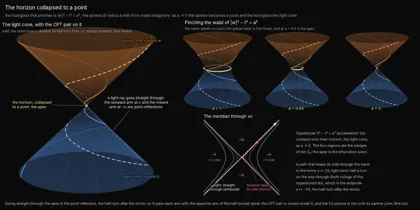 17The horizon collapsed to a point
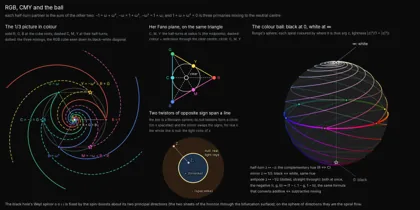 18RGB, CMY and the ball
12 October 2026
ζ on a ball: turns, crushes and mirrors
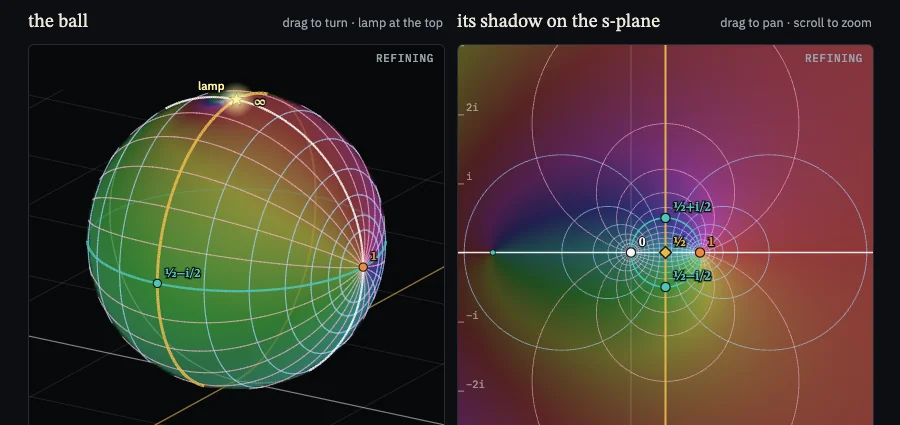
The zeta ball, to turn yourself
Drag the ball, or turn it a quarter at a time about its three axes, and watch its shadow on the s-plane. Paint it with ζ or ξ, and slide from the plane phase into ζ.
Open the zeta ball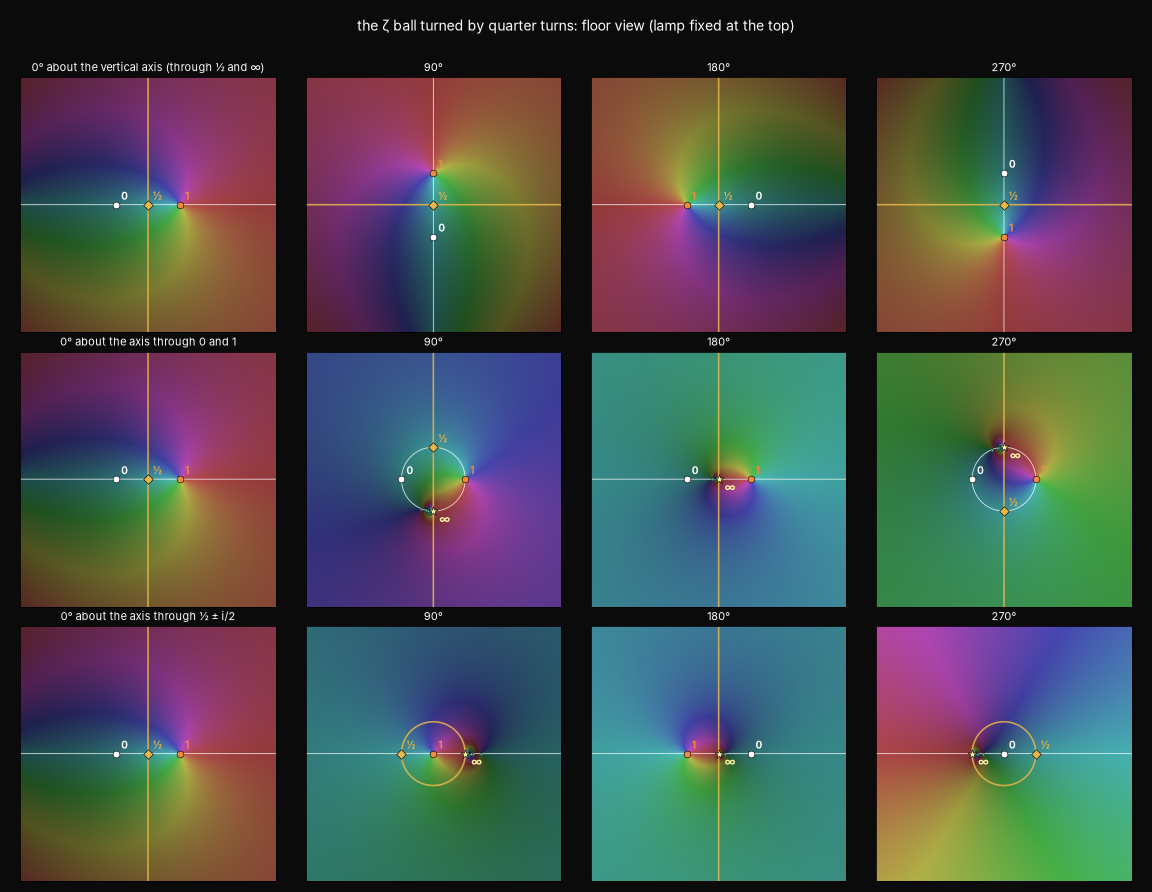
1Quarter turns
ζ painted on a ball, colour showing its phase, and seen from the floor after quarter turns about three axes: through ½ and ∞, through 0 and 1, and through ½ ± i/2.
2The plane phase
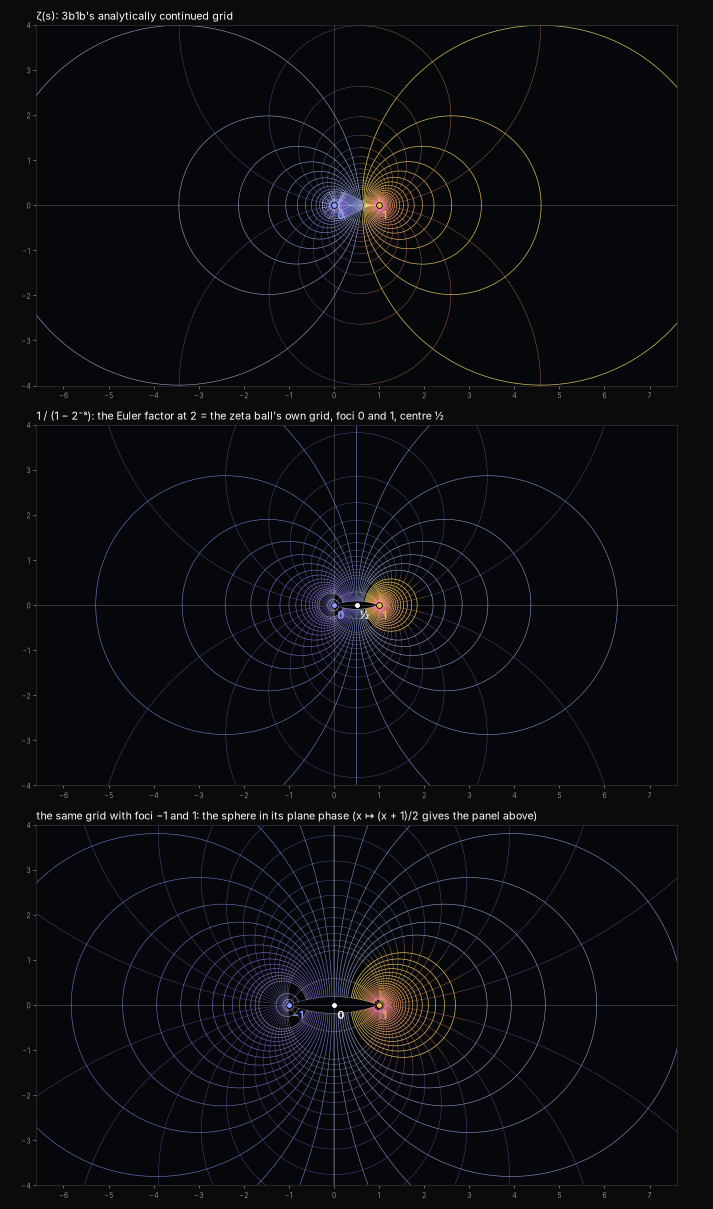
3Blue1Brown's continued grid under ζ, then under 1/(1 − 2⁻ˢ), whose grid is the zeta ball's own: foci 0 and 1, centre ½. Moving the foci to ±1 gives the same sphere in its plane phase.
3Thermographs as resting balls
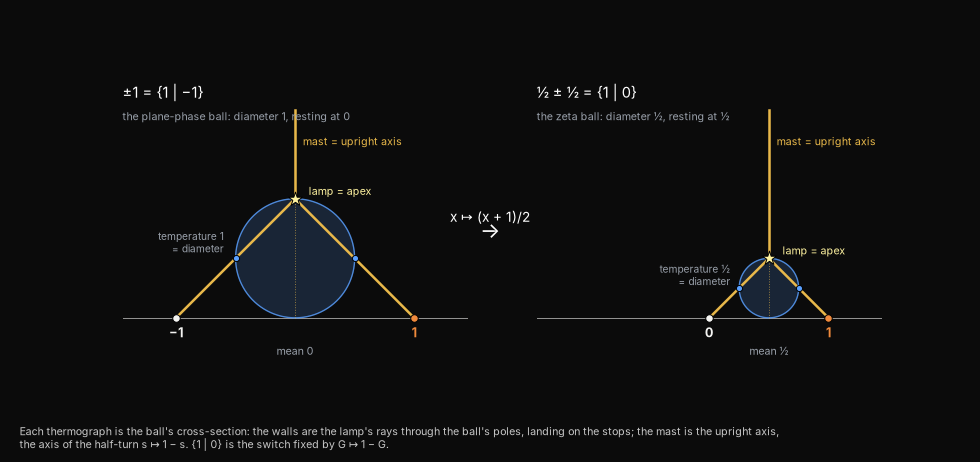
±1 and ½ ± ½ drawn as cross-sections of balls resting on a line: the lamp's rays through the poles make the walls, and the upright axis makes the mast.
4Dividing by zero is a turn
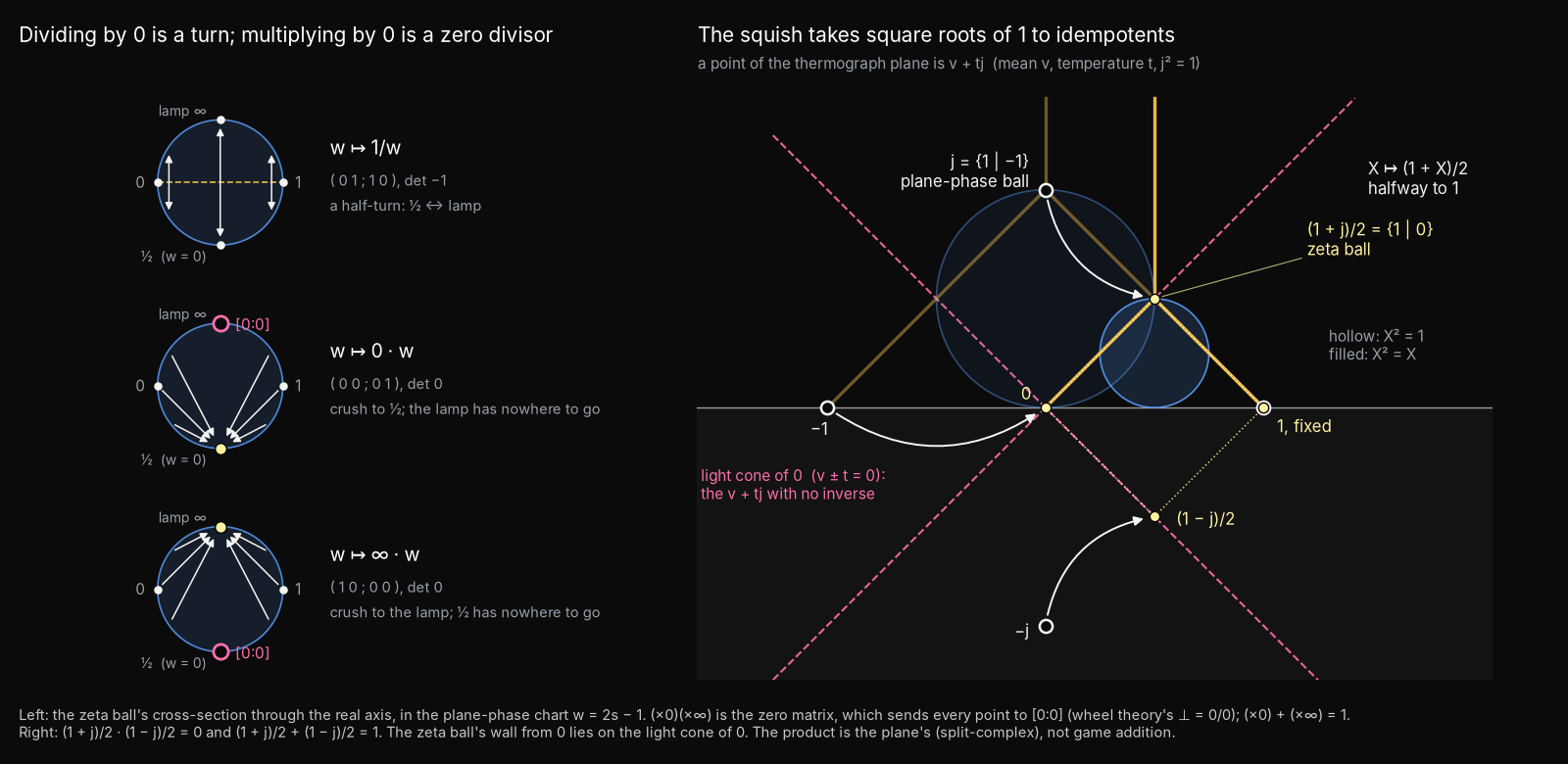
On the ball, w ↦ 1/w is a half-turn, while multiplying by 0 or ∞ crushes every point to one: a zero divisor. The squish (1 + X)/2 then takes square roots of 1 to idempotents.
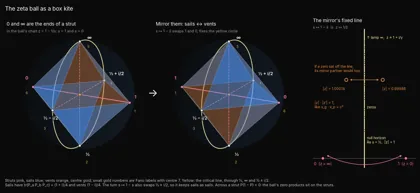
5The ball as a box kite
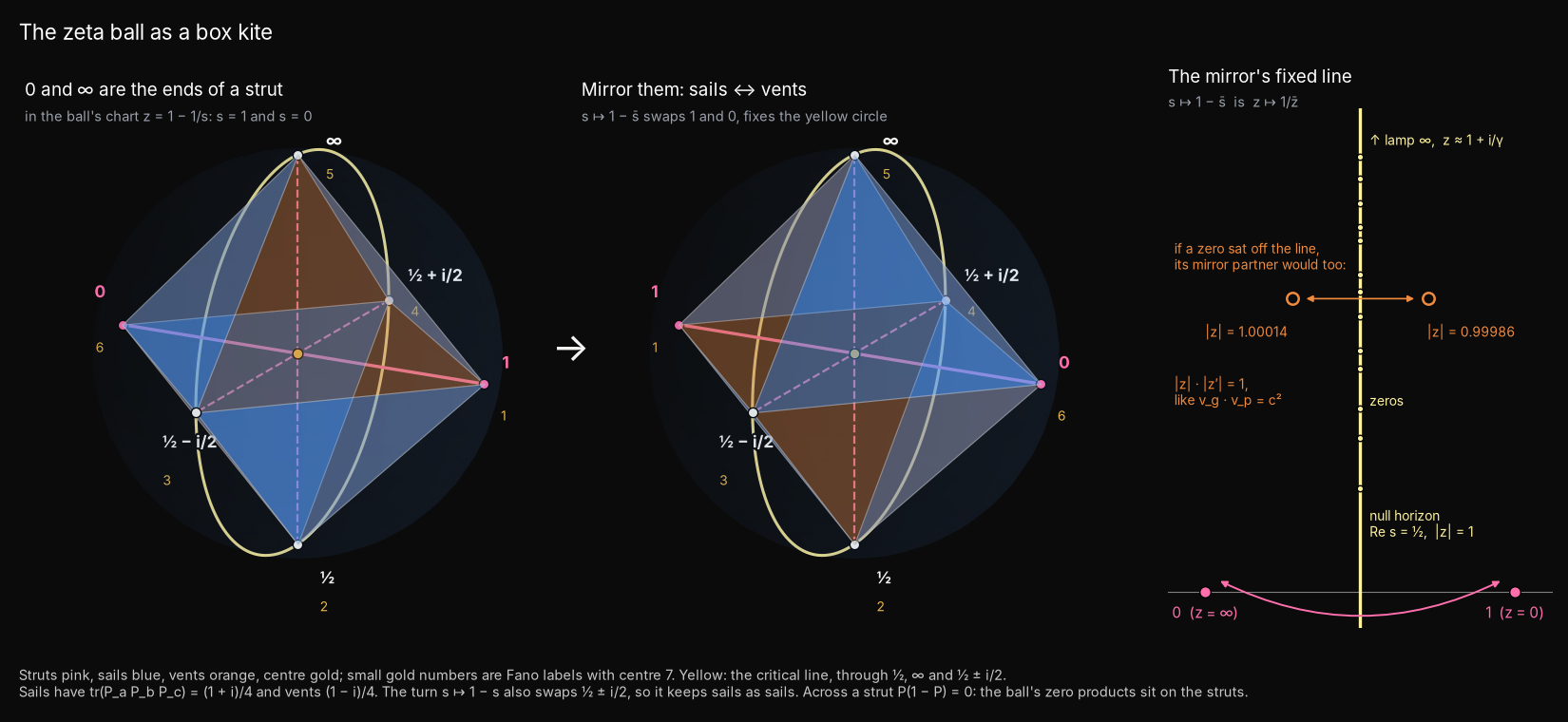
The ball's six frame points as a box kite: 0 and ∞ are the ends of a strut, and the mirror swaps sails and vents while fixing the critical circle.
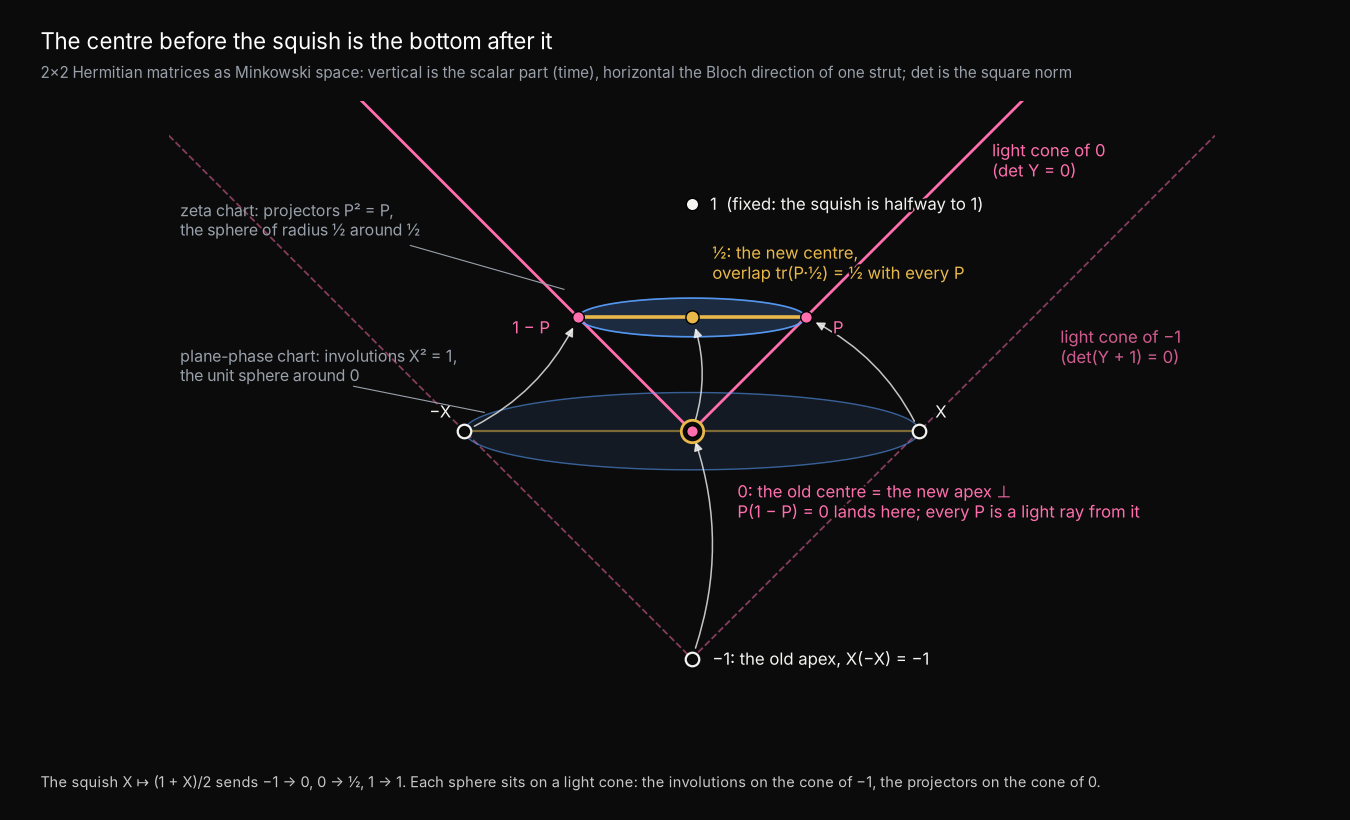
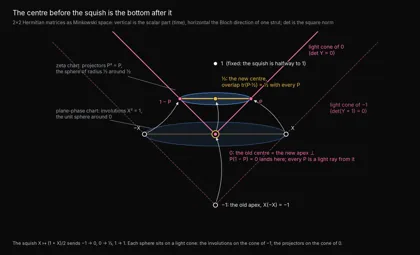
6The centre becomes the bottom
With 2×2 Hermitian matrices as Minkowski space, the squish sends the old centre to the new apex, so each sphere sits on a light cone.
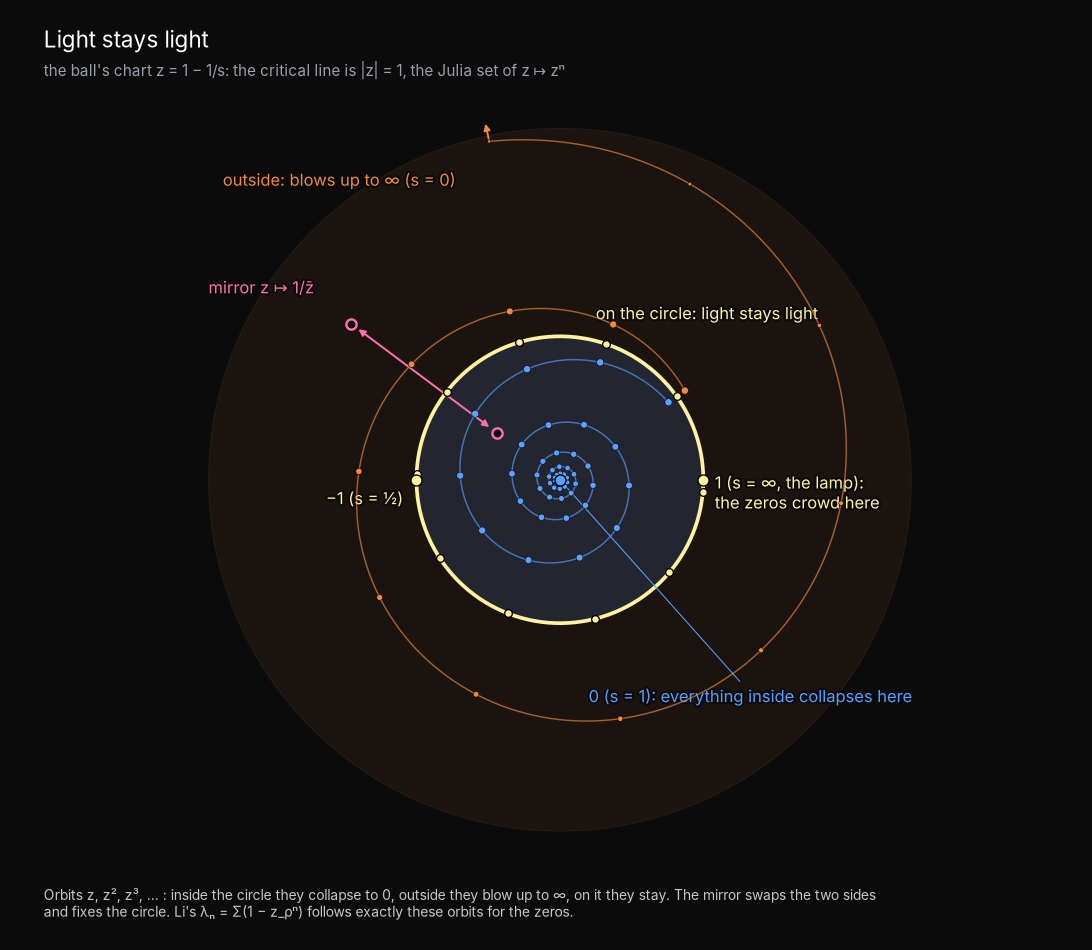
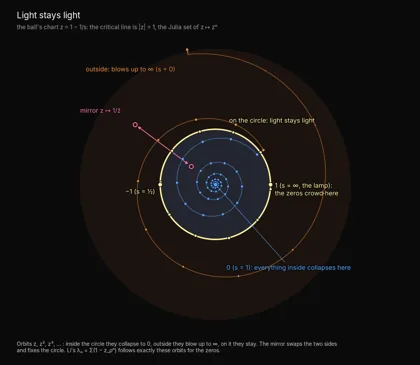
7Light stays light
In the chart z = 1 − 1/s the critical line is the unit circle, the Julia set of z ↦ zⁿ: orbits inside fall to 0, orbits outside run off to ∞, and orbits on the circle stay on it.
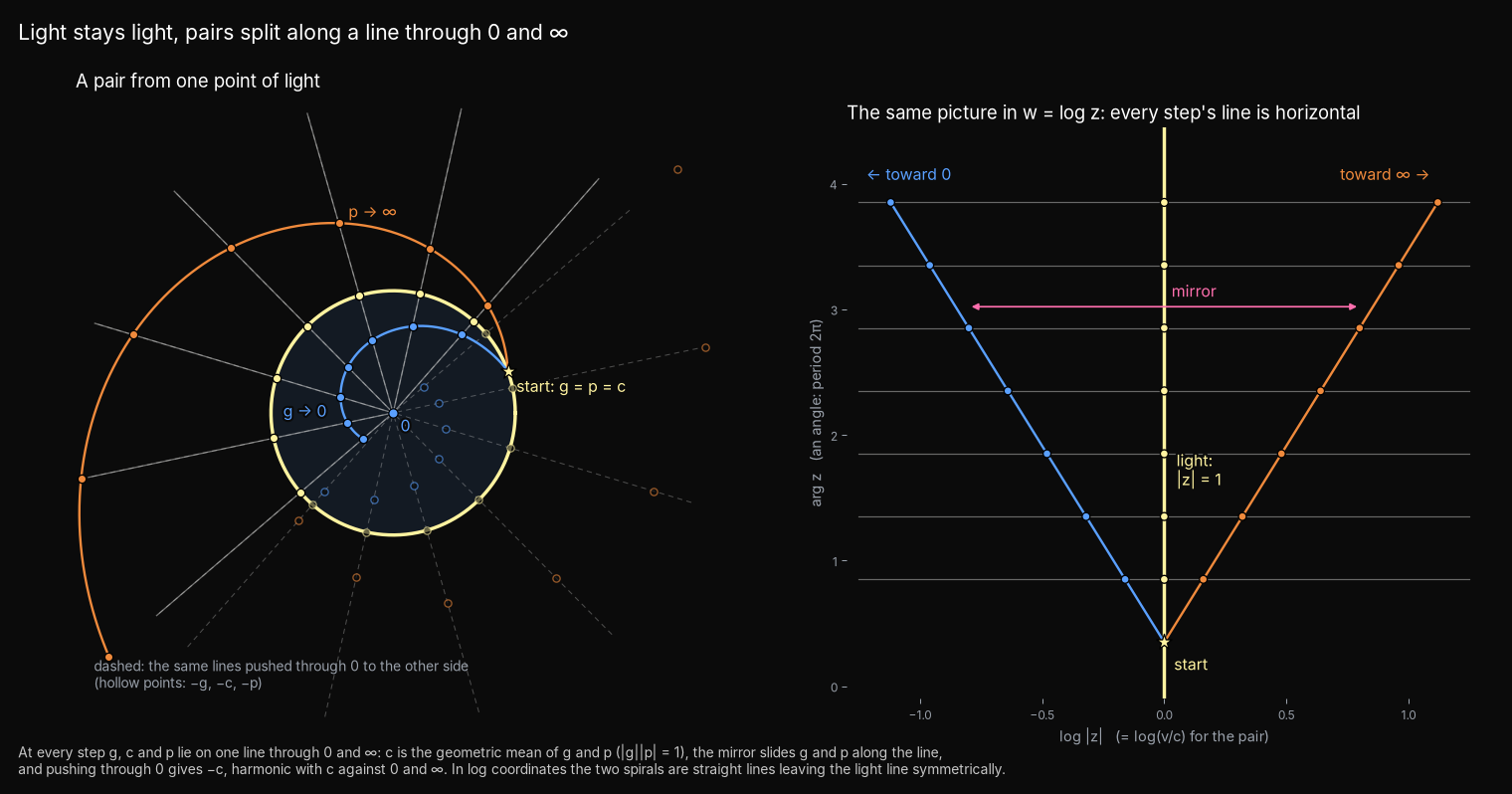
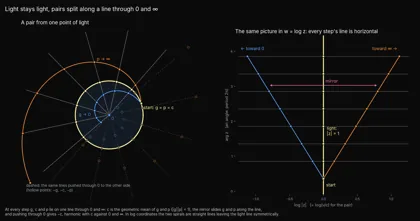
8A pair from one point of light
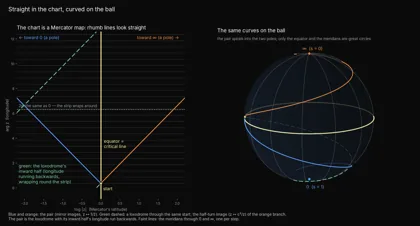
Two mirror-image log spirals leave a point of the circle, one winding into 0 and one out to ∞. In log coordinates they are two straight lines leaving the light symmetrically.
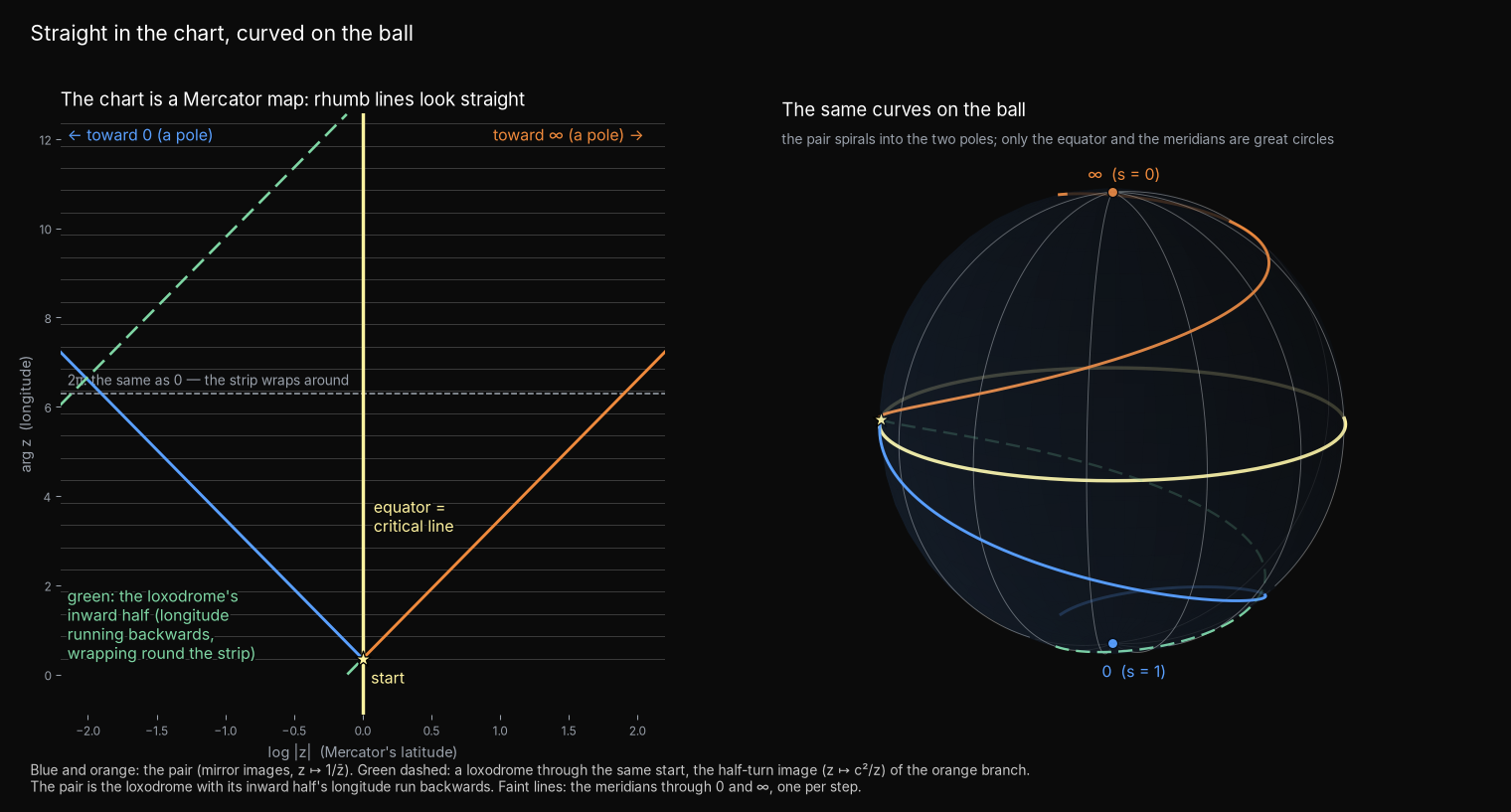
9Straight in the chart, curved on the ball
The log chart is Mercator's projection of the ball, so the pair are rhumb lines: straight on the map, spiralling into the two poles on the ball.
13 October 2026
Spirals, horizons, light cones and colour
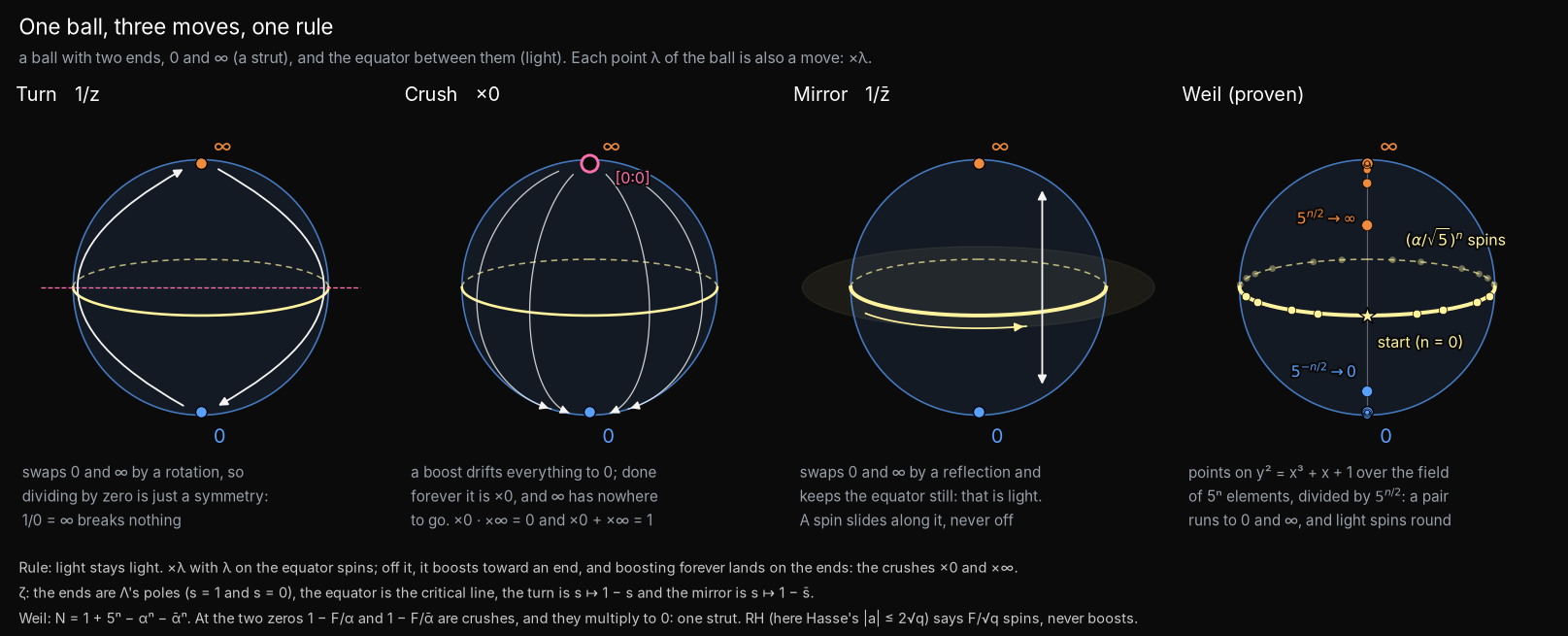
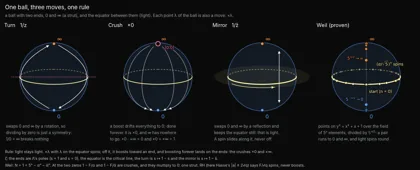
10One ball, three moves, one rule
The turn, the crush and the mirror on one picture, tried on Weil's curve y² = x³ + x + 1 over F₅: its two zeros are the ends of one strut, and Hasse's bound is a spin rather than a boost.
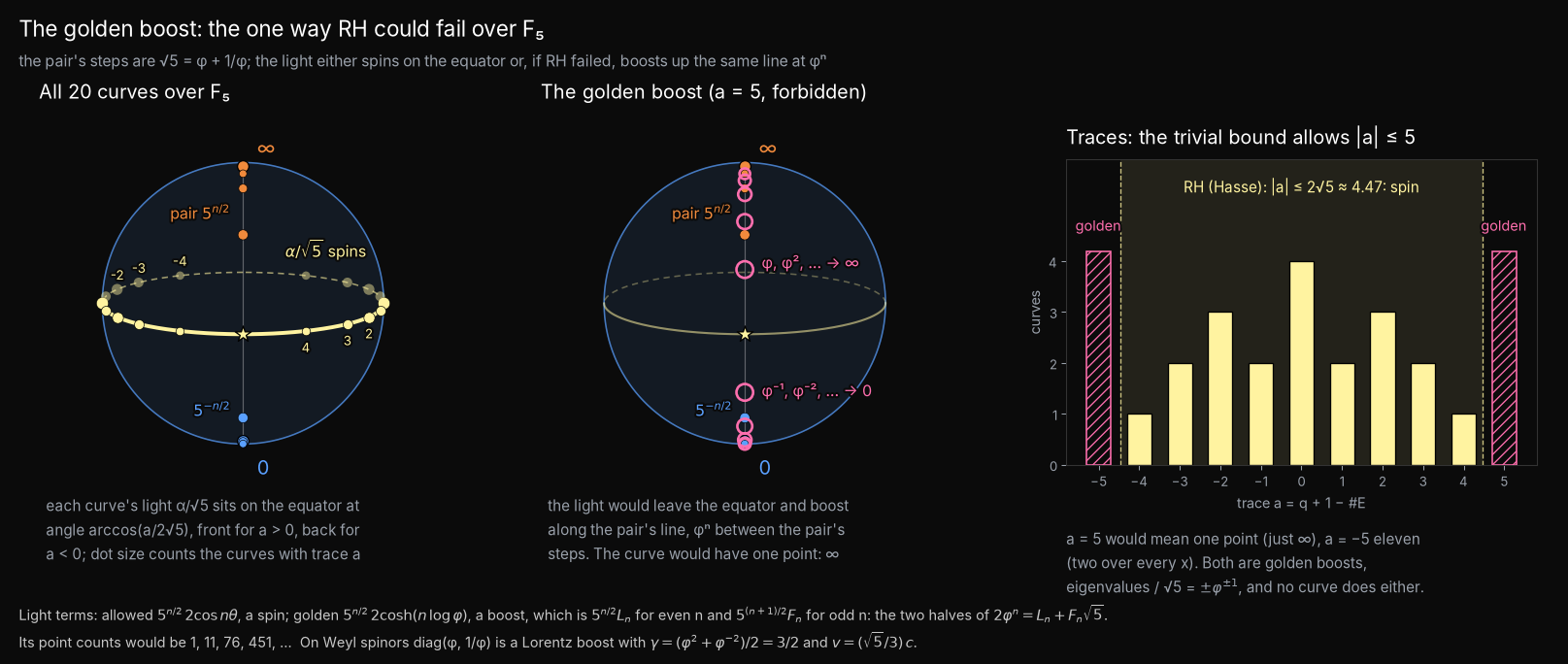
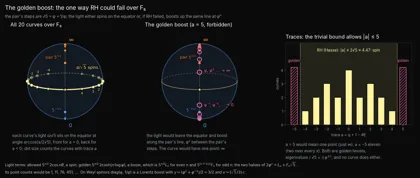
11The golden boost
All twenty curves y² = x³ + Ax + B over F₅ have traces between −4 and 4. The traces ±5, which would break the Riemann hypothesis, would be golden boosts, with cosh in place of cos.
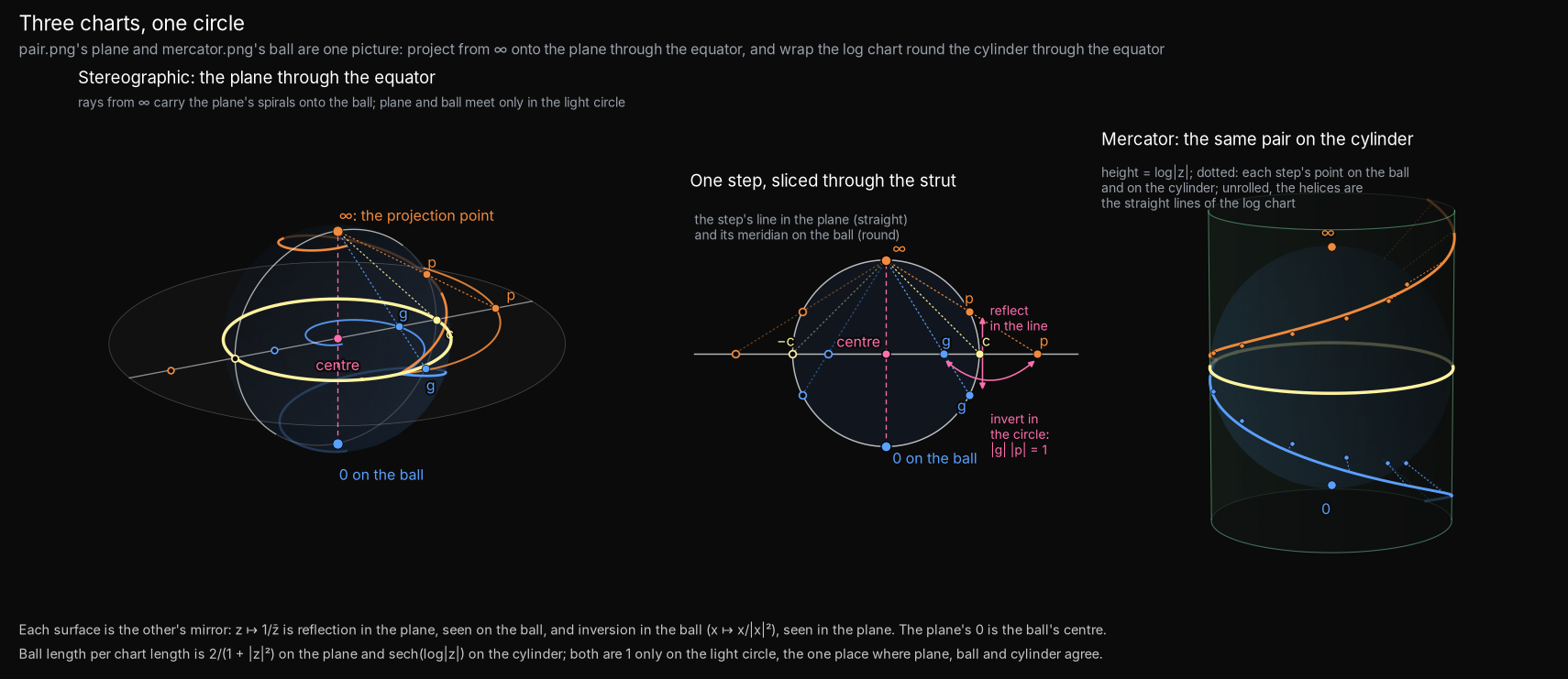
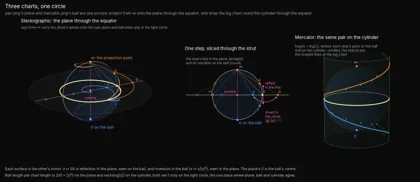
12Three charts, one circle
Stereographic projection joins the flat plane, the ball and Mercator's cylinder. Their scale factors, 2/(1 + r²) and sech(log r), both equal 1 only on the light.
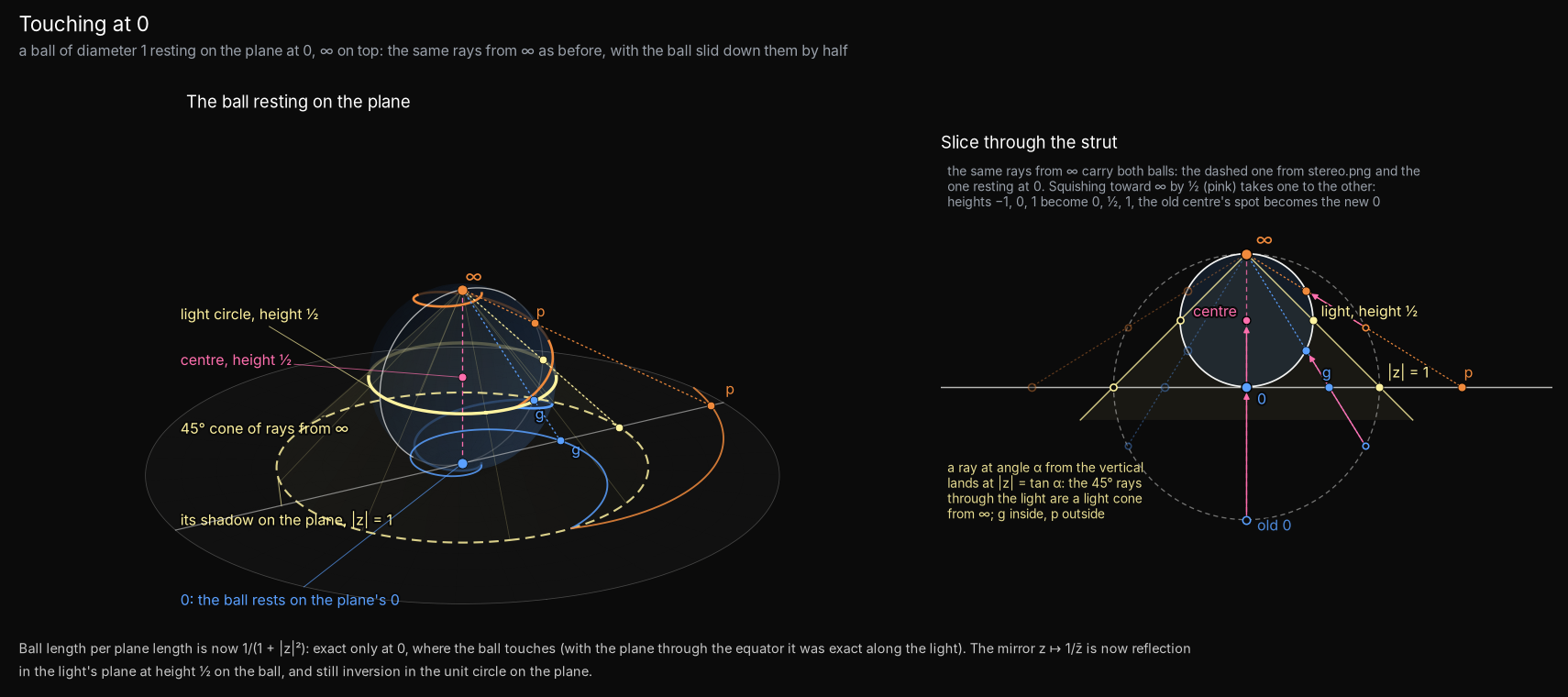
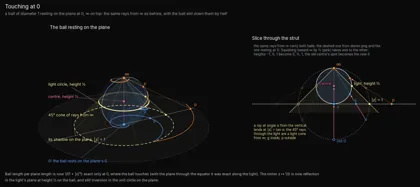
13Touching at 0
A ball of diameter 1 resting on the plane at 0: the same rays from ∞, the light circle at height ½, and the cone of rays through it, a light cone from ∞.
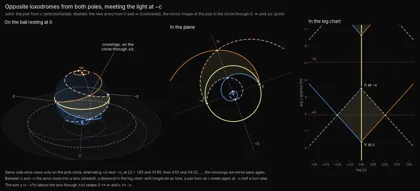
14Opposite loxodromes
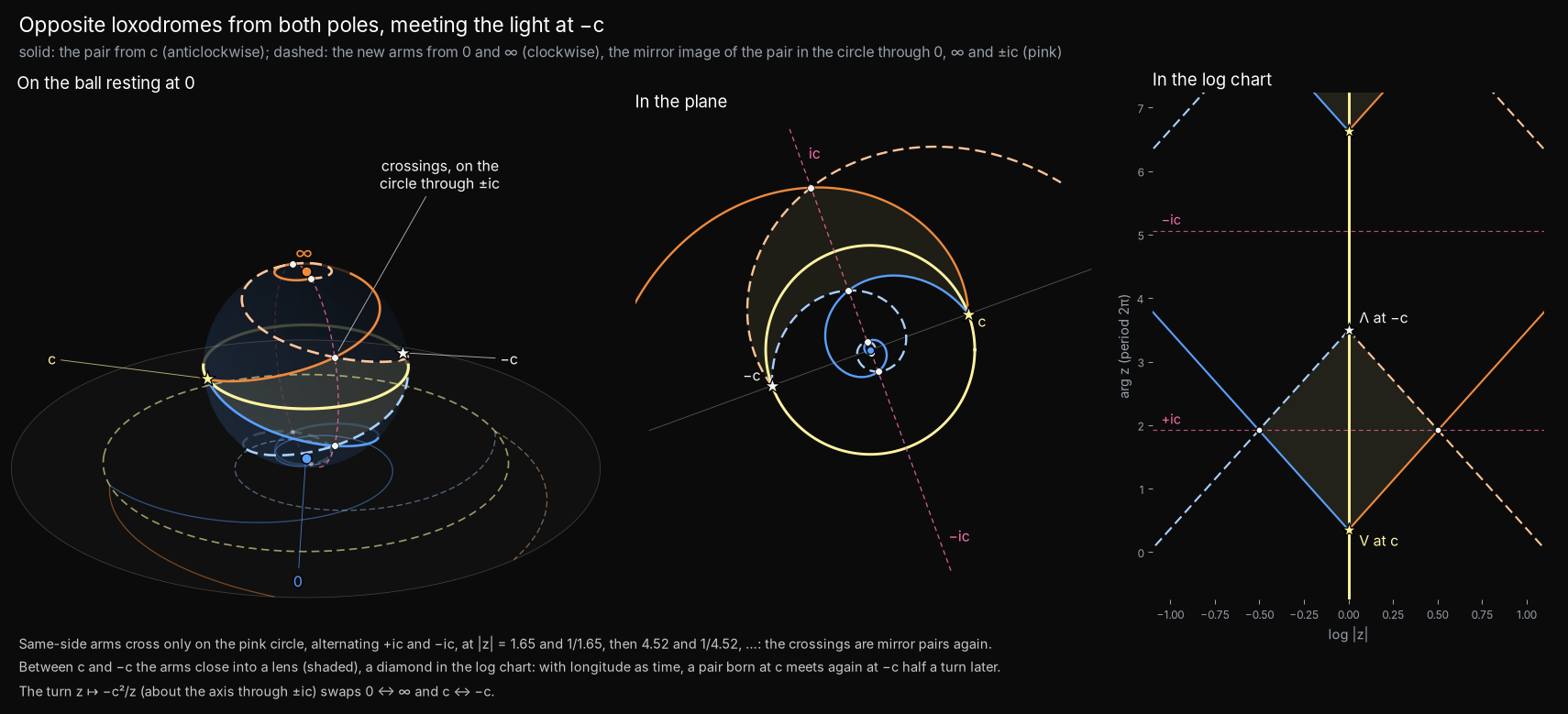
Loxodromes from both poles meeting the light at −c: the pair's mirror image, a V at c and a Λ at −c in the log chart.
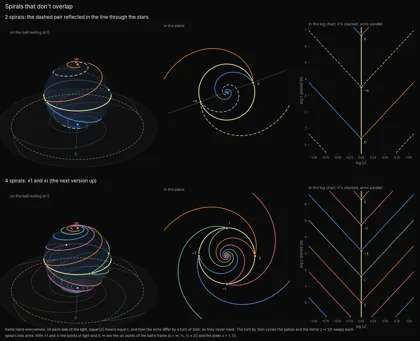
15Spirals that don't overlap
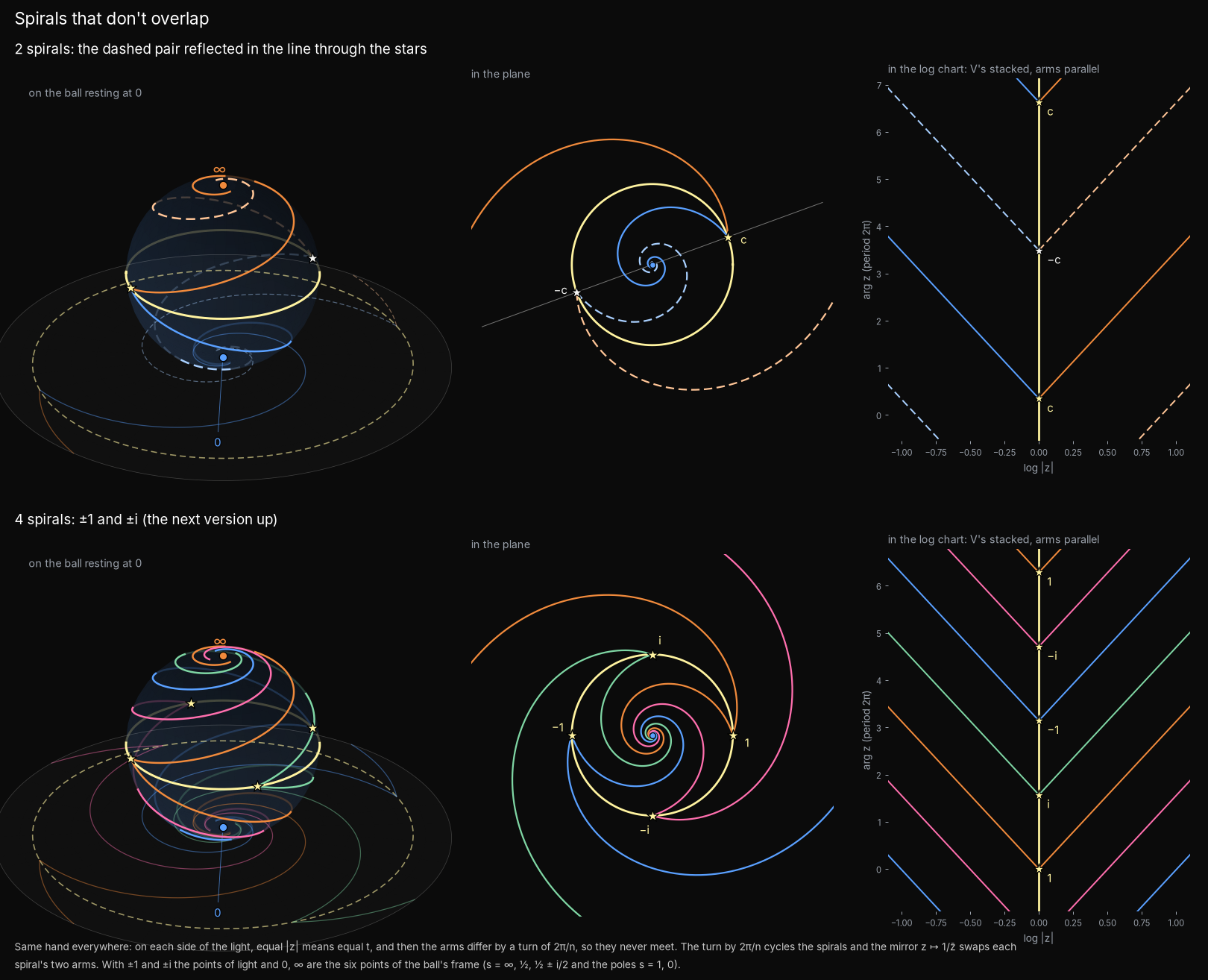
The pair and its half-turn: two spirals with the same hand that interleave without meeting. The next version up has four, ending at ±1 and ±i.
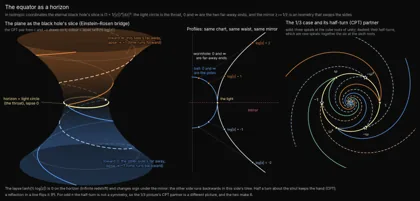
16The equator as a horizon
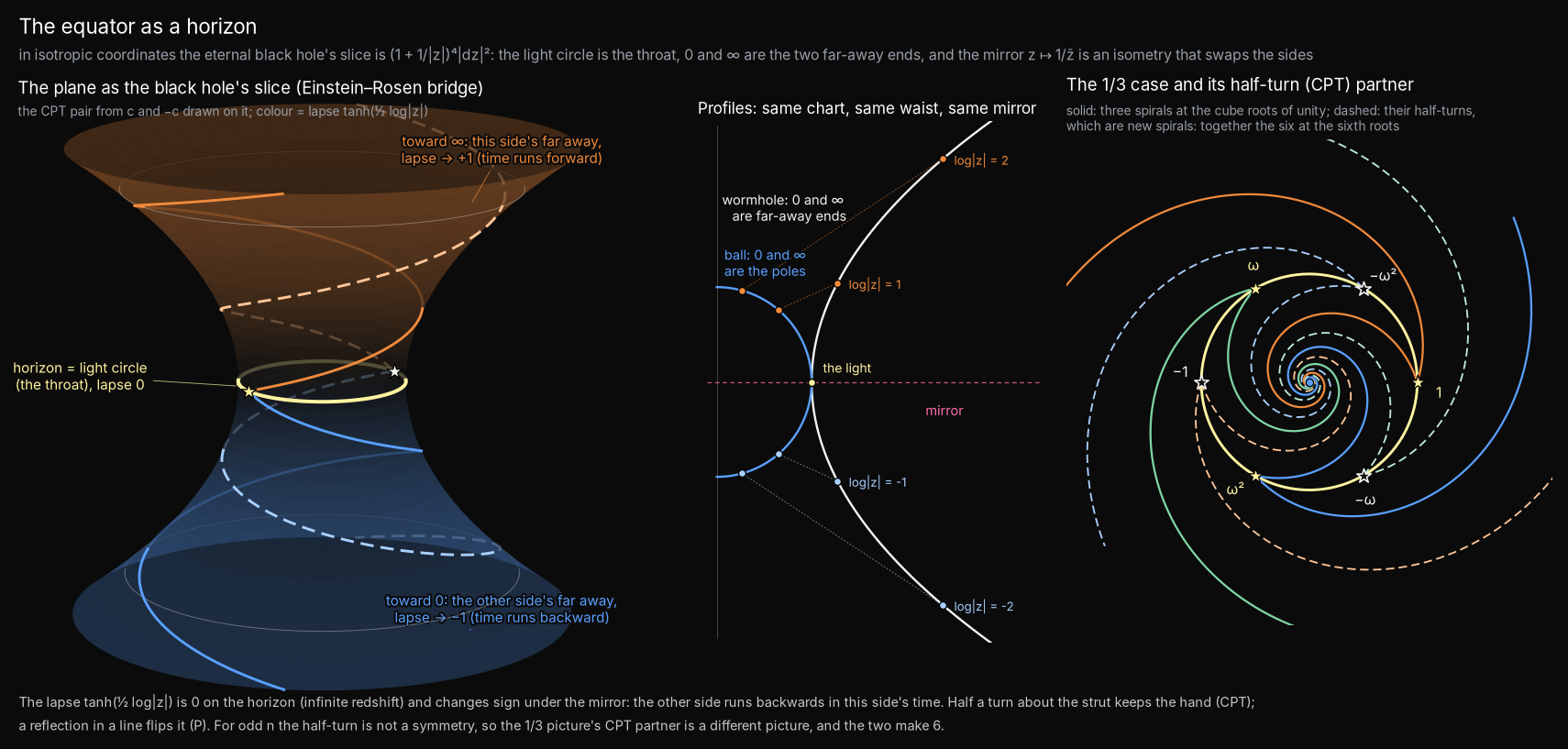
The plane as the slice of an eternal black hole: the light circle is the throat, 0 and ∞ are the two far-away ends, and the mirror swaps the sides while the clock runs backwards on the other side.
17The horizon collapsed to a point
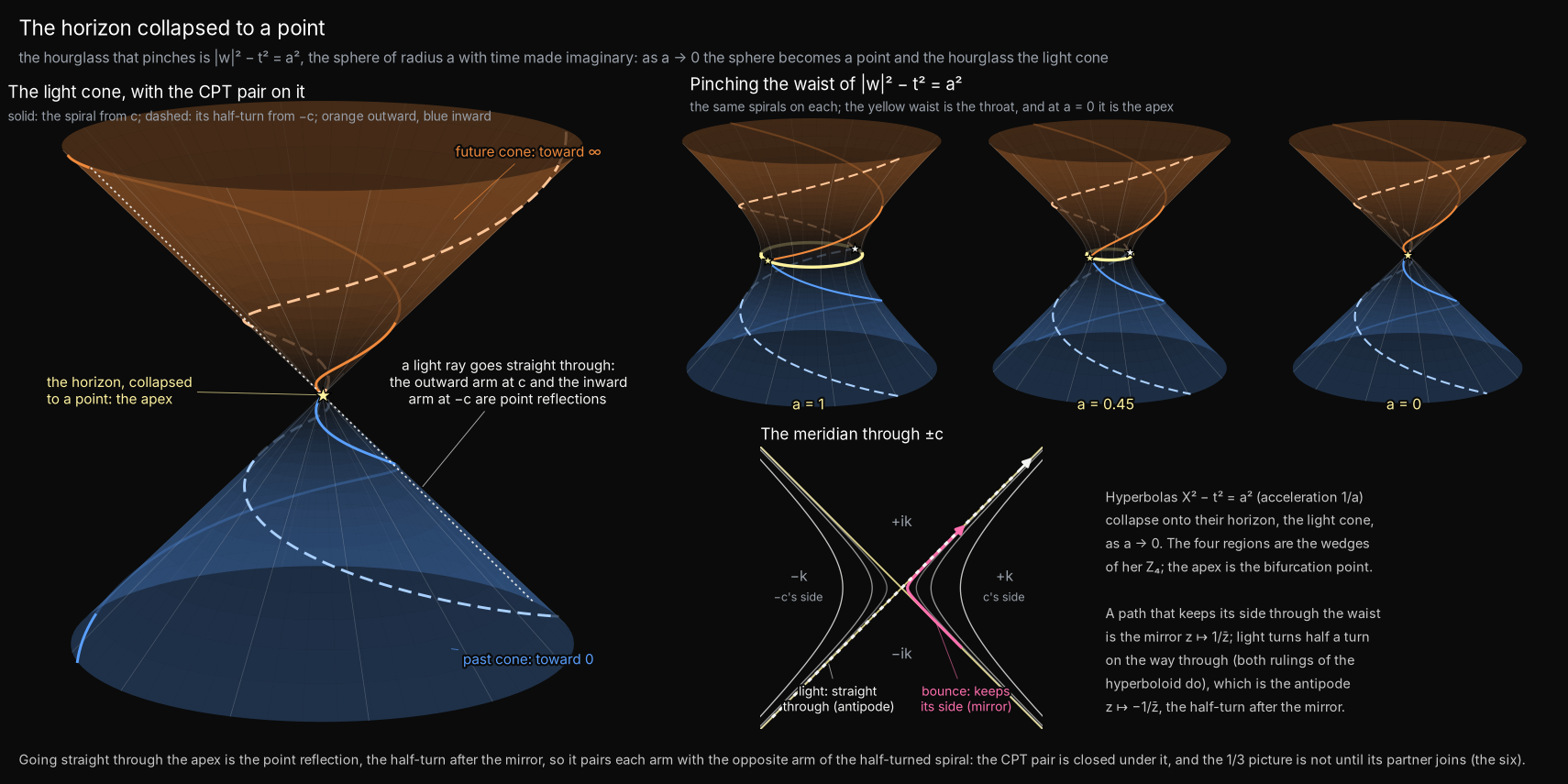
Pinch the hourglass |w|² − t² = a² and it becomes the light cone, with the throat as the apex. A massive path bounces and keeps its side; light goes straight through to the opposite side.
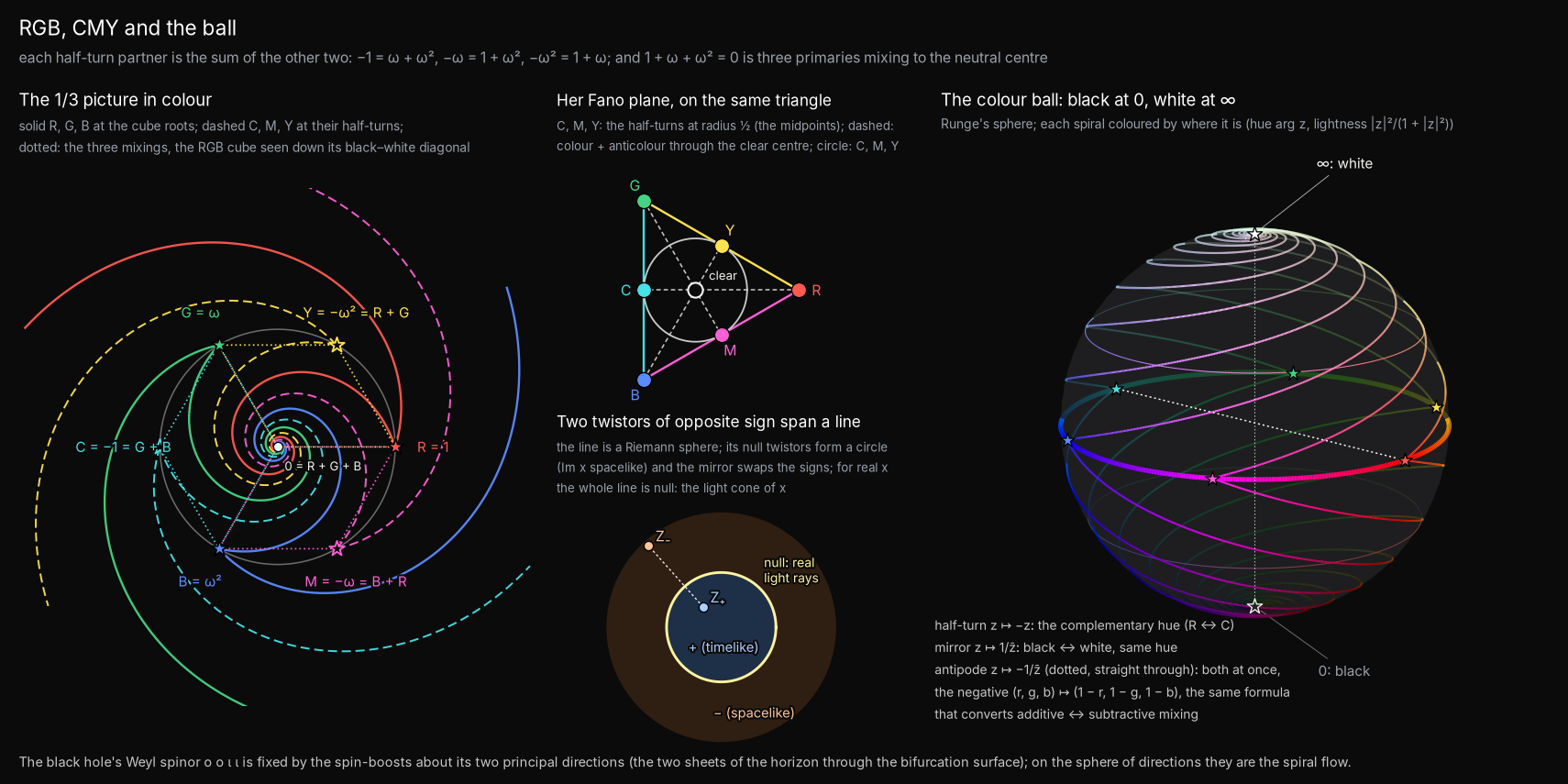
18RGB, CMY and the ball
Each half-turn partner is the sum of the other two (−1 = ω + ω²), so the cube roots and their half-turns are the RGB cube seen down its diagonal. On the colour ball, the antipode is the photographic negative.